Wednesday, November 13, 2013

Random Movie #6: The Wind that Shakes the Barley

For our sixth random Netflix movie, Becky and I saw the 2006 war drama The Wind that Shakes the Barley.  I have wanted to see this movie since it first came out in 2006.  Initially it was because it looked interesting and starred Cillian Murphey.  Later, this grew to include its Palme d'Or win from that year (best described as the equivalent of winning a Nobel Prize in film).

Damien (left) and Teddy (right)

In rural 1920s Ireland, Dr. Damien O'Donovan (Cillian Murphey) prepares to leave his hometown for a job in a London hospital.  After a farewell game of Hurling (a game similar to Field Hockey), a group of English soldiers confront them for hosting an illegal public gathering, resulting in the summary execution of friend Micheál Ó Súilleabháin (Laurence Barry).  After his initial misgivings about fighting an unwinnable war, Damien's brother Teddy (Pádraic Delaney) convinces him to join the Irish rebels in their war against English oppression.  But while Teddy is satisfied to compromise with the English, Damien will not be satisfied until Ireland achieves full independence.


The Wind that Shakes the Barley is an a-typical war drama, having far more in common with dialog-heavy dramas like 12 Angry Men than with action-laden epics like Saving Private Ryan.  Rather than focusing on the sanguine skirmishes between the Irish rebels and English troops, the film emphasizes the surrounding debate of Irish nationalism and independence.  The real battles are not fought amidst the fields of Anthenry over territorial gains, but in the court rooms and churches over the distribution of wealth and the exact nature of the new Irish government.  The war itself, which ends 45 minutes before the end of the film, merely exists to provide context for such a debate.  


The film is a deeply immersive experience that steeps the viewer in the fiercely-fractured context of 1920s Ireland.  Its title - The Wind that Shakes the Barley - is drawn from Robert Dwyer Joyce's tragic ballad of the same name, which is sung during Micheál Ó Súilleabháin's funeral.  The song, which strongly parallels O'Donovan's own story, tells of an Irishman torn between his nationalist love of Ireland and his romantic love of his sweetheart.  After his lover is murdered by an English soldier, he joins the IRA and fights in the war.  Its choral references of barley refer to the fact that the Irish rebels would carry barley in their pockets as marching provisions.  When soldiers killed in combat were buried, the barley would take root and cover their unmarked graves.

Another song prominently featured in the film is Óró, Sé Do Bheatha Abhaile, a traditional ballad that was intensely popular during the Irish War of Independence.  The song welcomes home the soldiers who have "scatter[ed] the foreigners" that have threatened the country, comparing them to national heroes like the pirate queen Grace O'Malley.  It is performed by the Irish rebels emerging from a fog-seeped road, marching toward the a stationary camera and accompanied only by their footfalls.  Though it lasts less than a minute on camera, it remains one of the most enthralling and memorable moments within the film.


At the heart of The Wind that Shakes the Barley is an intensely personal tragedy.  Much like the American Civil War, which pitted entire families against one another, brothers Damien and Teddy ultimately find themselves on opposing sides following the Ireland's eventual treaty with England, which turns Northern Ireland into a Puerto Rico-like commonwealth that remains under English control.  Damien refuses to stop fighting until Ireland is completely independent of England, accusing Teddy of "wrapp[ing himself] in the [...] Union Jack: the butcher’s apron."  Teddy, fearful of England's threat of "an immediate and terrible war" if hostilities should continue, believes that the treaty is the best possible outcome that they, a rag-tag group of rebels, could hope for.


The Wind that Shakes the Barley easily numbers among the best war movies ever made despite, paradoxically, de-emphasizing the events of the war proper.  Unlike most films, where anticipation breeds disappointment, this one was well worth the seven-year wait.  While Becky only rates this exceptional film an 8, I rate it a 9, placing it on par with the likes of Apocalypse Now, Lincoln and A Man Escaped.

Monday, November 4, 2013

Random Movie #5: Don't Be Afraid of the Dark

For our fifth Netflix installment, we returned to one of my additions to the bucket: the 2010 horror film Don't Be Afraid of the Dark.  First shown to me by an intensely enamored friend, it seemed to me that it would be something that Becky and I would enjoy watching together.

Eight-year-old Sally Farnham (Bailee Madison) has recently moved to Rhode Island to live with her estranged father Alex (Guy Pearce) and his girlfriend Kim (Katie Holmes) while they restore the ancient Blackwood Manor for resale.  Even though Alex and Kim try to make her feel welcome, all she wants to do is to go back to her old home with her mother.  One morning, while exploring Blackwood's extensive grounds, Sally discovers a hidden chamber accidentally frees a tribe of pixie-like creatures.  It is only afterwards, however, that she realizes that they want to kidnap her and bring her to their warren under the manor.  Her father refuses to believe that she is telling the truth, leaving her to defend against these nocturnal invaders on her own.


Though not an altogether inaccurate label, I would hesitate to advertise Don't Be Afraid of the Dark as a horror film.  Doing so creates an inaccurate set of expectations in the viewer (similar to my opinion of The Texas Chainsaw Massacre or The Last House on the Left).  Between its whispered threats and murine antagonists, it is intimately more creepy than terrifying.  It could be more appropriately described as a melancholic meditation of the effects of a broken home on a too-often overlooked child.

To this end, the film is structured less like a modern horror film than it is a Greek tragedy.  The imps in the house are only a threat to Sally, whose most formidable weapons are a night light and a Polaroid camera.  Though he was capable of stopping the imps' assault throughout the film, Alex is too preoccupied with his work to take even the slightest notice of the danger that his family is in.  By neglecting Sally's need for companionship when she first arrived, he opened her to the tempting offers of friendship that the imps promised her in exchange for releasing them.  By refusing to believe Sally's increasing visible fears, he placed all three of them perpetual danger.  By refusing to leave the house when even Kim was begging him to, he ensured that the creatures would tear his family apart.  Although Alex himself survives the ordeal, he is burdened with the guilt of knowing that his constant inaction directly resulted in the film's tragic climax.

By starring a girl who was only eight-years-old at the time that filming began, director Troy Nixey and writer / producer Guillermo del Toro took a considerable risk with the emotional core of the film.  The old Hollywood adage, "never work with animals and children," is a direct warning against making this exact kind of child-centric film.  The quality of child actors is notoriously unpredictable, running the gamut from Daniel Radcliffe to Jake Lloyd.  "Not terrible" is often the best that anybody can expect.


Bailee Madison, however, gave a rare and moving performance as the haunted Sally Farnham.  Her character is surprisingly complex, torn between her instinctual need for her father's protection and her aversion toward a man who is essentially a complete stranger to her.  Madison's performance captures every nuance of a girl forced into a broken family.  She conveys the sour resentment of being uprooted from a reasonably stable home, the giddy wonder of a girl discovering strange new "friends" and the desperate need to be believed.  Amidst a solid-but-forgettable cast, she succeeds at giving a truly exceptional performance.


Don't Be Afraid of the Dark features all of the darkly beautiful visuals that are characteristic of Guillermo del Toro.  Blackwood Manor, rooted with secret passages and draped in heavily saturated colors, is entrancingly beautiful.  It is a pristine vision of old world opulence.  This, in turn, is contrasted against the savage imps that infest its walls, nightmarishly rendered on paper as often as they emerge from the shadows.


On the whole, Don't Be Afraid of the Dark is a solidly entertaining and reasonably executed horror film.  Becky and I agree that this film is a solid 7, comparing favorably to Alien, Carrie and E.T.: The Extra-Terrestrial.

Thursday, October 31, 2013

Random Movie #4: Grave Encounters

Our fourth random movie was one of Becky's additions to our Netflix Bucket: the 2011 horror film Grave Encounters.  Becky had seen this months ago and had been trying to get me to see it ever since.  For some reason I was never really interested in it, despite being the kind of movie that I usually like.  It turns out that it takes blind luck of the draw, rather than reasoned discussion, for her to get her way.

Like Ghost Hunters, Grave Encounters is a paranormal investigation show.  The show's cast consists of host Lance Preston (Sean Rogerson), occult specialist Sasha Parker (Ashleigh Gryzko), psychic medium Houston Grey (Mackenzie Gray), cameraman T.C. Gibson (Merwin Mondesir) and technician Matt White (Juan Riedinger).  For the latest episode of their show, they visit a haunted psychiatric hospital in Canada, where they lock themselves in overnight while they conduct a paranormal investigation.  After a seemingly uneventful night, they become trapped in the hospital, terrorized by the very ghosts that they came looking for.


Grave Encounters, like the more famous Quarantine and Cloverfield, is a found footage horror film.  In an attempt to create verisimilitude, the film has been shot in such a way as to appear authentic footage from a paranormal investigation.  The only things that we see or hear as audience members are what the numerous cameras placed throughout the hospital (or carried by the protagonists) have shot.  We are forced to literally adopt the perspective of the protagonists that, experience tells us, are all doomed.  Their fear is made all the more palpable since the audience is fully immersed into the protagonists experiences.

The film is essentially a superior version of The Blair Witch Project.  The updated premise ( a ghost hunting show) comes off as far less forced than its predecessor's (a group of students filming a documentary in the woods).  The rotting fixtures, nonsensical graffiti, immersive shadows and labyrinthian hallways of the derelict psychiatric hospital were the best possible combinations of the impossible layout of The Shining's Overlook Hotel and Silent Hill's corrosive infrastructure.


While a large number of scenes in The Blair Witch Project unrealistically stretched the assumption that the characters themselves shot the footage (scenes where they bickered and argued with one another over where to hike or who was to blame for getting them lost).  Realistically, the characters would either have been too absorbed in finding a solution to their problem or too angry with one another to record the increasingly bitter arguments for posterity.  In Grave Encounters, however, the found footage premise never forces itself upon the action of the film.  Since a number of cameras had been set up prior to the start of the investigation, it makes sense that there would be footage of events that the protagonists were otherwise too preoccupied to shoot themselves.  Additionally, the basic premise of the film necessitated that they wanted to record proof of the paranormal, so it would only stand to reason that they would continue filming beyond the point that a group of college students working on an unrelated project would.

Grave Encounters also features a far more experienced and far more capable cast.  The Blair Witch Project starred three purely amature actors.  The film was the debut of actors  Michael C. Williams and Joshua Leonard and it was actress Heather Donahue's first non bit-part.  Their  inexperience showed throughout the film, where they merely shifted from calm to angry to unconvincing bouts of crying.  They succeeded in reading their lines and marching through the woods, but that was all.  Grave Encounters' cast is vastly more experience, each credited with non-recurring tv and film roles.  While the cast of The Blair Witch Project had difficulty conveying even simple emotions convincingly, this film's cast plays off one another with the ease of experience.  Mackenzie Gray easily shifts between his duel roles of irreverent actor and dramatic spiritualist Houston Grey while Sean Rogerson embodies the charismatic, self absorbed Lance Preston with practiced deftness.


Grave Encounter's The Vicious Brothers show a greater and subtler ease helming their film than Eduardo Sanchez and Daniel Myrick did with theirs (despite both pairs having no previous directing experience).  The frequent and seemingly random switches between color and black and white in The Blair Witch Project were needlessly jarring, preventing the fully immersive experience that the found footage genre seeks to create.  The more-occasional (though still frequent) shifts between color and night-vision maintained Grave Encounter's verisimilitudinous qualities while eliciting the same unease and sense of "wrongness" that the green-tinted lights are commonly used for in horror films; it succeeds in creating tension without succumbing with unthinking ease into convention.  Likewise, the use of fixed-position cameras at present locations offered a third-person perspective to the events of the film that The Blair Witch Project lacked.

Grave Encounters' one great fault is that the exact "whys" of the plot are not immediately evident after the first viewing.  While they are there, they are threaded through heavy exposition in the form of interviews before the protagonists' overnight lock-in at the hospital.  It is exceedingly easy to miss this information and even easier to forget it when the action of the film gets underway.


Overall, the film is an effective and entertaining addition to the found footage horror genre.  It features far superior acting, directing and writing than The Blair Witch Project and far steadier camerawork than Cloverfield.  Becky and I both give it a rating of 7, putting it on par with the aforementioned Cloverfield, Cabin Fever and both Fright Nights.

Tuesday, October 29, 2013

Random Movie #3: Carrie


For our third randomly selected Netflix movie, Becky and I saw Carrie, the 1976 horror film adapted from Stephen King’s first published novel.  Becky selected this particular movie for the bucket mostly, I would imagine, because of her interest in seeing the remake that stars Chloë Moretz and Julianne Moore (which we were able to see together shortly after watching this movie).


Carrie White is a shy, awkward girl who simply does not fit in at school.  Despite being a senior in high school, she gets her first period while showing after gym.  Believing that she is bleeding to death, she becomes hysterical and begs the other girls for help.  Instead of calming her down, they laugh and throw tampons at her while screaming “plug it up.”  In the aftermath of this incident, Carrie begins to develop telekinetic powers, which her fundamentalist mother is convinced is witchcraft.  One remorseful classmate, eager to atone for what she did to Carrie, convinces her boyfriend to ask the social outcast to Prom.  Another classmate, however, enraged at her punishment over the incident, plans the ultimate way to humiliate Carrie.

The story of Carrie is far more tragic than it is horrific.  Like the more recent Let the Right One In, Carrie emphasizes the human violence done to its protagonist rather than the supernatural violence that she inflicts on her tormentors.  Carrie is a quiet, meek girl who is mercilessly bullied by her classmates, physically and emotionally abused by her mother and generally ignored by the teachers and administrators that could otherwise have helped her.  Even Ms. Desjardin, her gym teacher, slaps her in a moment of supreme vulnerability in plain view of her bullies.  While Ms. Desjardin later punishes the girls for what they did, it is only after she shows all of them what you’re supposed to do to Carrie White.


If there was one this that the film could be faulted for, it is the overly inventive direction of Brian De Palma.  While I can appreciate the numerous directorial decisions that he makes in presenting Carrie’s tragic story, they do keep the movie from aging gracefully.  During the montage where Tommy and his friends choose which tuxedos to rent, rather than cutting from tux to tux, De Palma fast-forwards through the "unimportant" parts.  When Carrie’s own head is spinning from Chris’ unimaginably cruel prank, De Palma recreates this by using a rotating kaleidoscope lens.  During the carnage of prom night, De Palma uses a split screen to show co-current violence against the students and faculty.


Some of these techniques worked very well; the split screen particularly strikes me as well executed, evoking the chaos and confusion of Carrie’s rampage.  Most, however, are distracting, dated and poorly executed.  Taken as a whole, it is a visual cacophony that is far more interesting than good.

The film features an absolutely outstanding cast.  Sissy Spacek perfectly embodies the frightened, introverted Carrie White.  She is alternatingly able capture the intense savagery of her rage and the complexity of her accompanying guilt.  Piper Laurie plays what is by far the most terrifying character in the entire film: Mrs. White.  While both she and Spacek channel the jilting, unnatural, overly-stylized body language of German Expressionism, Laurie excels well beyond Spacek in this capacity.  She succeeds in creating what is by far the most unsettling on-screen presence since Max Schreck's Count Orlock, similar to Carrie's own physical mannerisms during her prom-night rampage.


Carrie is ultimately an incredibly good, though incredibly dated, film.  While De Palma’s unique filming techniques do not hold up well in contemporary viewings, the tragic and emotional core of the film (not to mention Spacek and Laurie's exceptional performances) does.  I rate this film a strong 7.5, on par with I Walked with a Zombie, The Last House on the Left and Suspiria.  Becky rates the film a 7.

Thursday, October 24, 2013

Random Movie #2: Equilibrium

Another random movie has come and gone without incident.  For our second selection, Becky and I saw the 2002 sci-fi action film Equilibrium which was, needless to say, a pretty stark contrast to Monsoon Wedding.  This was another film that I had previously seen that I thought that Becky would enjoy (this time on recommendation from a friend).


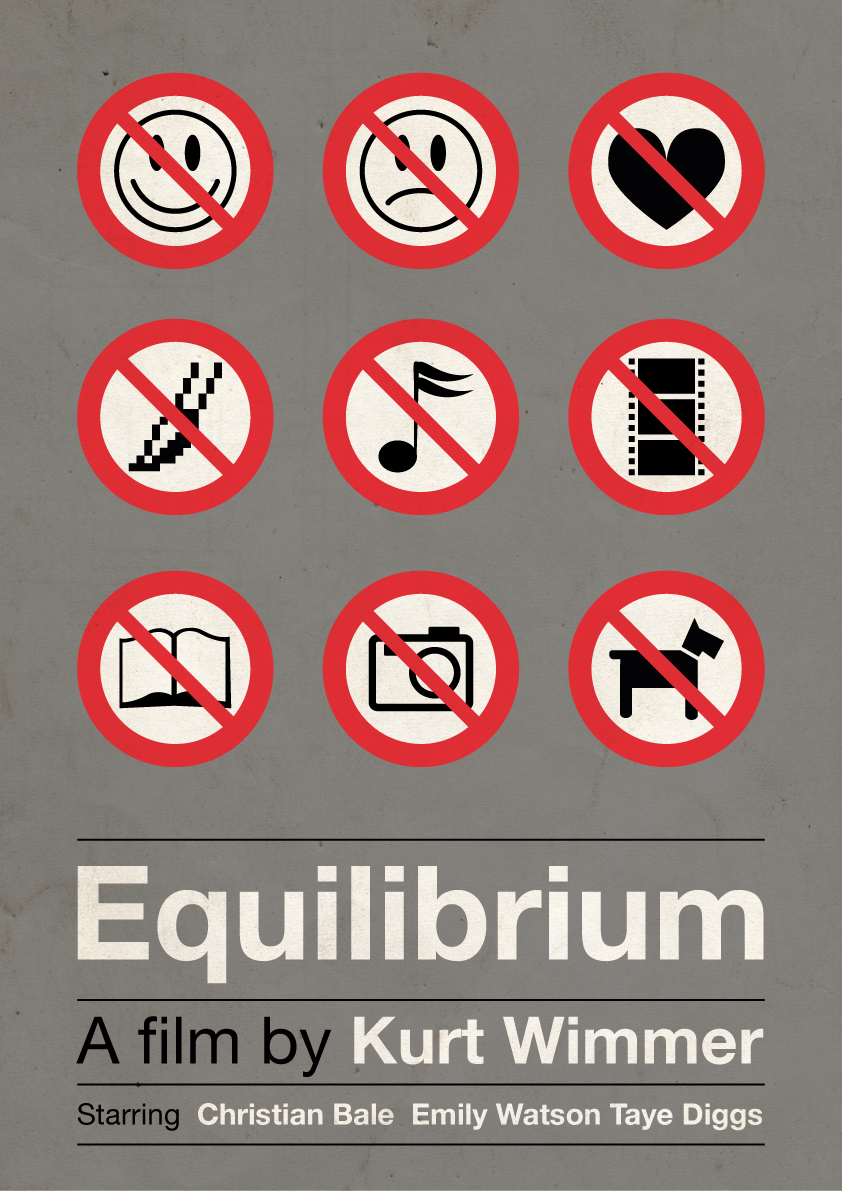
The film is set in the aftermath of a devastating third world war.  As humanity crawls from the ashes to rebuild its shattered civilization, it is agreed that the world will not survive a fourth such war.  In order to prevent mankind's extinction, the new government attacks what they see as the root of "man's inhumanity toward man: his ability to feel."  By governmental decree, the entire populace is medicated with an emotional suppressant called Prozium and anything that could elicit an emotional response (which ranges from the Mona Lisa to puppies) is strictly prohibited.  Both failure to medicate and possession of banned materials are capital offenses.

John Preston (Christian Bale) is a Grammaton Cleric: a special operative that suppresses terrorists who have gone off of their state-mandated Prozium and incinerates any contraband that they might possess.  After accidentally missing a dose of Prozium himself, Preston begins to feel for the first time: awe at the beautiful works of art that he destroys, remorse for killing his rogue partner and sympathy for the men and women who simply refuse to be medicated any longer.  While he tries to make sense of these new emotions, he becomes a double agent for the terroristic resistant movement while attempting to dissuade his new partner's growing suspicions about his loyalty to the state.

Equilibrium is basically what would happen if the Wachowski brothers directed Fahrenheit 451: a slick, stylized action-thriller with some incredibly riveting fight sequences.  As masters of Gun Kata, a combination of martial arts and markmanship, the Grammaton Clerics are this film's equivalent of The Matrix's Agents.  In the very first scene, we see John Preston enter into a blackened room surrounded by armed terrorists.  After they send off some panicked, scattered fire and a few whispers, Preston makes a series of precise shots to every man in the room.


While it's not exactly "the thinking man's action movie," it never-the-less is thoughtful.  The treatment of the dystopic future is very intimately unsettling.  Robbie Preston (John's son) is largely comes off as the second coming of The Omen's Damien: calm, composed, insightful - essentially nothing like what an actual child is like (owing to Prozium).  The tragedy that befalls Preston's wife is genuinely heart-wrenching, both in John's inability to defend her and the nature of why it happened to her.  Most memorable of all is the Clerics' inability to understand why the terrorists would keep adorable Bernese Mountain Dog puppies (one going so far as to ask if they ate them)


While the film is not without its faults - including a minor case of Reindeer Games' "One Twist Too Many" Syndrome - they are not so great as to detract from what is an admittedly exciting film that delivers everything that it promises.  While essentially a poor man's Matrix, it is still a more thoughtful, measured and entertaining addition to its genre than most other action movies.  Both Becky and I rate this film an 8, putting it on par with The Boondock Saints, Fearless and I Am Legend.

Monday, October 21, 2013

Random Movie #1: Monsoon Wedding

For our inaugural random movie, Becky and I ended up watching Monsoon Wedding, a 2001 Indian romantic comedy.  This selection was one that I had added to the movie pool.  I had previously viewed it in one of my film classes at ISU and thought (correctly so) that it would be one that Becky would enjoy watching.

The film follows a traditional, Punjabi Hindu family in the days immediately preceding the arranged marriage of daughter Aditi Verma with Texas Indian Hemant Rai.  But, as ever, the course of love does not run smoothly.  Increasingly anxious over the prospect of marrying a man that she has never met before (and moving halfway around the world with him), Aditi begins an affair with her married ex-boyfriend.  The mounting pressures of the wedding begin to compound with Lalit Verma's (Aditi's father) increasing financial difficulties and concerns over his son's effeminint behavior (cooking, dancing and not playing sports).  P.K. Dubey, the wedding planner, falls in love with the Verma's servant Alice, who shuns him due to an embarrassing misunderstanding.  Cousin Ayesha begins seeing a visiting Australian, Rahul, behind everybody's back.  And, on top of all of this, a dark secret from adopted daughter Ria's past threatens to break the family apart.


Monsoon Wedding is able to successfully combine the relatable humor of My Big Fat Greek Wedding with the deeply personal tragedy of The Celebration.  The film doesn't focus on any one plotline or set of characters.  Instead, director Mira Nair is able to deftly balance and develop every plot she introduces to fruition (similar to Joss Wheddon juggling an incredibly full cast of characters in The Avengers).  Aditi's anxieties over the wedding are weighed equally with her father's;  Ayesha's light-hearted secret is balanced against Ria's heart-rending one; even the romance between Aditi and Hemant does not over-shadow P.K. and Alice's own courtship.  Every story has its moment to shine.

The most impressive aspect of the film is that despite the increasingly dramatic nature of the Verma's problems, Nair avoids succumbing to histrionics.   Instead of sickeningly over-the-top drama, she offers us dramatic composure.  And, in doing so, she is able to create a complete image of the family, not just one or two individual characters or plotlines.


Monsoon Wedding is the film that My Big Fat Greek Wedding wanted to be: a sometimes-comedic, sometimes-dramatic big-picture view of a large family's wedding.  The real difference between them is that in Monsoon Wedding, family is shown to be comforting and protective rather than suffocating and often very silly.  This is an exceptionally entertaining production with an infectiously vibrant energy woven throughout the film.  Ultimately, I would rate this film an 8.5, putting it on par with Much Ado About Nothing,  Silver Linings Playbook and Persona.

Friday, October 11, 2013

Prologue

I think that it's safe to say that we've all been there: sitting in front of tv, Netflix titles scrolling past, arguing over what to watch.  For Becky (my girlfriend and movie partner of 4+ years) and me, this was par for the course.  Sometimes we would find a movie that we both wanted to see.  Sometimes one of us would give in to the other so that we could at least watch something before we had to go to bed.  Usually, however, we'd just settle on old episodes of Archer or The IT Crowd.


I was tired of the tedious negotiations.  Tired of always circling back to the same shortlist of safe choices that we had already seen ad nauseam.  Tired of my watchlist hopelessly outstripping my ability to keep it in check, especially when so many movies on it were streamable on Netflix.  Mostly, though, I was just tired of all of the excitement being sapped from sitting down to watch a movie.


After this last week's debacle, I told Becky to make a list of movies in which she could say either "I have not seen this movie, but want to" or "You have not seen this movie yet, but should" about each one.  When she was done, I combined her's with a list of my own.  I printed the list out, cut the titles into strips, folded the strips and put all of them into a massive pilsner.  From now on, whenever we wanted to watch a new movie on Netflix, we would give the cup a few shakes, pull out a random movie title and watch that.

When all was said and done, we had 138 movies consisting of a diverse mix of genre, acclaim, subject matter and release dates.  Some were there just to show the other person (War Games, Grave Encounters).  Some had won Academy Awards (Midnight Cowboy), AFI Awards (Lost In Translation) or the Palme d'Or (The Wind that Shakes the Barley).  Some were silent (Metropolis), in a foreign language (Tsotsi) or just plain weird (Lars and the Real Girl).  Some were action (Mission: Impossible - Ghost Protocol), comedy (Duck Soup), horror (The Hamiltons), western (True Grit), documentary (Jiro Dreams of Sushi) or drama (A Late Quartet).  All told, it was pretty impressive.

The account which follows is our 100% reel journey into the savage, unexplored reaches of Netflix.