Monday, September 1, 2014

In Defense of Iron Man 3

In case it wasn't already obvious, there are major spoilers about the plot and characters of Iron Man 3 and the Marvel One-Shot "All Hail the King" in the post that follows.  You have been warned.

We are living in a Golden Age of superhero films.  The traditionally maligned "nerd" genre is officially mainstream and arguments over "Marvel vs DC" pop up more frequently than "Jordan vs Lebron."  Marvel is raking money in hand over fist with an unprecedented string of blockbuster hits and DC is finally making good live-action movies that aren't about Batman.  Superman is an interesting character for the first time since 1938 and Guardians of the Galaxy - let that sink in for a second, Guardians of the fucking Galaxy - is the must-see blockbuster in theaters right now.


Perhaps the most controversial thing that you could say in this brave new world of cinema - even more than "I liked Man of Steel" - is "I liked Iron Man 3."  The argument against Iron Man 3 generally comes down to its Shyamalan twist: that Tony Stark's (Robert Downey Jr.) arch-nemesis, The Mandarin (Ben Kingsley), is really just Trevor Slattery - a drug-addled, lecherous, alcoholic, focus-grouped actor hired to play the character of The Mandarin that was invented by Aldrich Killian's (Guy Pearce) think tank A.I.M.

Granted, there is a faction of any fan base that will be upset if anything is changed between the source material and film.  I've even heard somebody rail against Lionsgate changing the eye color of the dogs in The Hunger Games from what was described the book.  Those are not the kind of arguments that I am addressing.  I am concerned with the group of fans that are understandably upset that Iron Man's only really interesting villain (ie, the only guy who wasn't Nega Stark nor one of many forgettable Cold War era moustache twirlers) was turned into a red herring: a punchline at the expense of Iron Man's  arch nemesis.


I acknowledge that it is a lucid, intelligent, rational objection to an anti-canonical twist that nobody - and I mean nobody - saw coming.  And yet I cannot help but ultimately reject this line of thinking.  The Iron Man films have always been the Beverly Hills Cop of the Marvel Cinematic Universe - an action-comedy series whose protagonist always has a cheap trick and a cheesy one-liner at everyone else's expense.  It's the reason why Iron Man ended with the line "I am Iron Man" instead of S.H.I.E.L.D.'s cover story and the reason why Iron Man 2 ended with a humiliating jab at the obnoxious Senator Stern (Garry Shandling).  The only difference now is that the film's twist isn't a jab at a character's expense, but a sucker-punch at our's.  The villain who was just too good to be true turned out to be exactly that.

I can't help but feel that everybody's viewing Iron Man 3's Mandarin in the wrong light.  He is not a post-9/11 Venus, emerging fully-formed from the Middle East.  This is an origin story.  Trevor is a method actor: a breed of thespians noted for their ability to deeply entrench themselves in the psychology their characters.  They think and feel and act as that character would, both on and off the set.  This is further developed in the Marvel One-Shot "All Hail the King" (featured in the Thor: The Dark World DVD special features), in which the imprisoned Slattery basks in his newfound fame, bragging that "when an actor has inhabited a role as long as [he has], he often becomes it and it him."  Shortly afterwards, he is broken out of prison so that he can answer for his defamation of the actual, comic-inspired Mandarin.


This latest twist isn't an apologist ret-con of Iron Man 3's handling of The Mandarin, but of an origin story in the vein of Doctor Strange or The Shadow.  Imagine Trevor - an unstable man whose mind has latched onto the character of The Mandarin and refuses to let go - delusionally basking in the unprecedented popularity of his most successful role.  He now comes face to face with his muse: "a warrior king [who] inspired generations of men through the Middle Ages [and] perhaps even further back in time."  Like Bruce Wayne to Ra's Al Ghul, he is brought into the fold of his organization and, due to his intimate understanding of its leader, groomed for his succession, eventually emerging as the one true Mandarin that he always imagined himself to be.

I honestly wouldn't be surprised to see this as the basis of Iron Man 4 or even Avengers 4.  Maybe we'll see him get developed in Agents of S.H.I.E.L.D. as the main villain of season 2.  For now, though, let's all give the series some breathing space.  They pulled one Hell of a doosey on us with Iron Man 3 and got us all pretty good.  Some people didn't like being the butt of a joke, and that's understandable.  But since Marvel has shown an interest in further developing the character of The Mandarin, we should all just wait and see what avenues they will choose to explore with him.


Friday, August 29, 2014

Unreality Companion: Good Will Hunting

Since today is my official debut on Unreality, I thought that I would try something a little different - a little beyond the expressed scope of this blog (reviewing randomly-selected movies) that might turn out to be awesome.  On Fridays, I will post two articles: one on Unreality, one here.  Unreality will be a more deliberate, purposeful, kairotic review - something planned out in advance and chosen because of what's going on in the world.  The one for this blog will be a companion piece: something chosen to pair with and build upon what I wrote for Unreality.  You can certainly read either article in isolation and not miss anything.  However, I do believe that there is something to be gained from reading both articles: a greater truth in the juxtaposition.  Since my article on Unreality this week is a review of Good Morning, Vietnam, I thought that I would pair that with a review of what I believe to be Robin Williams' greatest film: Good Will Hunting.


Harvard's greatest mathematician isn't a tenured professor.  It isn't even a student.  It is Will Hunting (Matt Damon): a young janitor with a criminal history and a troubled past.  After starting a fight following a little league game, the court wants to throw him in Jail.  But Professor Gerald Lambeau (Stellan Skarsgard), who caught Will solving one of his high-level math problems, speaks on his behalf.  On the condition of attending therapy, the court agrees to remand Will into Lambeau's custody.  Will's contempt for his court-appointed therapists, however, leaves him with only one option to stay out of jail: Lambeau's estranged colleague from Will's side of the tracks - Sean Maguire (Robin Williams).

Good Will Hunting is the perfect storm of excellent writing, direction and acting.  The emotionally riveting script about a blue-collar savant who closes himself off from the world was written by then-unknowns Matt Damon and Ben Affleck while Damon attended Harvard.  Their Oscar-winning script seamlessly transitions between Boston's neo-Cockney streets and the reserved recesses of Harvard's ivory tower.  What is truly astounding, though, is the depth and sophistication that these novice writers were able to give to Will, whose deflections, evasions and anti-social behavior are the highlight of the film.


But it's not what he says that defines Will Hunting.  It's not even how he says it.  It's the things that he doesn't say, that he adamantly refuses to say.  We don't learn who Will Hunting is because he screams "You don't want to hear that I got fuckin' cigarettes put out on me when I was a little kid!  That this isn't fuckin' surgery, that the motherfucker stabbed me," but in the mischievous, crooked smirk when he figures out how to get to Maguire - by suggesting that "maybe [he] married the wrong woman" - and his stunned, cow-eyed silence when Maguire finally confronts him about it.

The film's real revelation, however, is Robin Williams.  His performance is the culmination of the promise that began with The World According to Garp and continued with The Dead Poet's Society.  Williams' Maguire leads a life of quiet desperation: a subtly layered, even-handed man who can connect with the real Will Hunting not because he is a brilliant psychologist, but because he sees shades of himself reflected in the "cocky, scared shitless kid" sitting across from him in his office.  Williams deftly plumbs the depths of his character, keeping the still-fresh pain of a widower just behind his eyes - almost, but not quite, visible.


Beyond Damon and Williams, the film features a remarkable supporting cast.  Ben Affleck gives an incredibly promising performance as Will's friend Chuckie Sullivan.  While it is not quite the breakout performance that Damon had, nor the scene-stealing brilliance of Williams', he does lay down the foundation of what was to come later in his career - of Argo, Hollywoodland and State of Play.  Minnie Driver gives the performance of her career as Will's girlfriend Skyler.  She is earnest in her attempts to break through Will's defenses and is heart-breaking to watch when Will rejects her for it.


Stellan Skarsgård gives as brilliant a performance as the ambitious Professor Lambeau as either of the two leads.  While he cares for Will and does everything in his power to help him succeed - including getting him an interview with the NSA - he does it not because he cares about Will the person, but because he cares about Will the mathematician - the genius who can usher in a golden age of mathematical understanding.  He is exactly the kind of person that Will rejects out of hand - aspiring, self-serving and consumed with what will "owe['s] to [him]self."


In fact, the only fault that I can find with the film is the romantic subplot between Will and Skyler - a story line which is far more necessary to Will's therapeutic development than it is entertaining to watch.  She exists purely because serves a function to the narrative, not because grew organically out of it.  While Minnie Driver delivers an excellent performance, her character is generally annoying and unimpressively developed.  


Good Will Hunting is a truly exceptional film - marking both the career highs of its veteran players (Williams, Skarsgård and Van Sant) and the emergence of an energetic new crop of creative talents (Damon, Affleck and Casey Affleck).  The material is deftly handled and beautifully rendered in its final form.  I would give the film a solid 9/10.

Wednesday, August 27, 2014

This Is Unreal

For those of you that have not heard, it's official: I am now a writer at Unrealitymag.com.  I will be taking over a weekly Friday column (starting this week) about basically whatever I can get the guy above me to sign off on.  Evidently this is what it feels like to be MovieBob.

Feels good.  Feels real good.

What I'm thinking is this: this blog will continue to focus on randomly-selected films (and potentially a few other odds and ends) and my Unreality columns will be selected with a bit more purpose behind their selection and intentionally kairotic (I know that my dad in particular will be happy with my debut column for Unreality).  Neither my blog entries nor my Unreality columns will cover the same films.  Each will be distinct from the other, with their own specific focus.

Thursday, August 21, 2014

Round 2: Fight!

So, as you may or may not have noticed, it's been a while.  But, as they say, good things come to those who wait, and the end is nigh (of waiting, that is).  Starting next week, I am going to resume reviewing randomly-selected Netflix movies again (starting with the back-logged Funny Games, which was definitely an interesting experience).

I am also going to start a second series of reviews, in which I randomly select a film from my own movie collection (because, let's face it, as a teacher at the start of the school year, Becky will probably not be free to Netflix with me as often as either of us would like).  The plan is to buckle down and post 1-2 reviews a week: at least one from either series, but hopefully one from both.  Down the line, I'm thinking of starting an intermittent series where I review tv series one season at a time and am going to additionally get some non-review content up as well (we'll just have to see exactly how often, though).

The idea is that this whole place is going to explode with regular, weekly content for the foreseeable future.

Actual clowns may vary.

Friday, December 13, 2013

Random Movie #11: Battle Royale

This last unhappy trend of movies (for which Becky is solely responsible) was finally bucked by a mutual pick: the 2000 Japanese action film Battle Royale.  Having previously seen the movie, which I initially took as a poor man's Hunger Games, I figured that it would be right up Becky's alley.  Having previously read the novel on which it is based, Becky got the exact same idea.

In the face of widespread social unrest (especially from the student population) Japan passes the B.R. Act.  This new law dictates that once each year, one randomly selected class of students will participate in a Battle Royale: a free-for-all fight to the death from which only a sole survivor will walk away from.  This year's participants, class 3-B, are fitted with electronic collars that will explode if there is no victor after three days.  Now, armed with randomly distributed weapons (ranging from paper fans to machine guns), it's every boy, girl and clique for themselves.


Battle Royale is both strongly and immediately comparable to The Hunger Games.  The premises of each are identical: a dystopic government, fearful of social uprising, abducts children and forces them to fight each other to the death as a means of terroristic control.  Both competitions are controlled by a centralized "game maker" who uses a variety of strong-arm tactics to funnel participants toward one another (ranging from The Hunger Games' traps / mechanized weaponry to Battle Royale's explosive collar and "danger zones").  Both include "career tributes" that have an unfair advantages in training and experience.  Both present alarming disadvantages in terms of the equipment distributed among the participants.  Both see the creation and dissolution of alliances as a means of survival.  Hell, even both sets of protagonists are romantically involved with one another.

The differences between the films, however, are infinitely more profound.  The Hunger Games functions primarily as a political allegory.  It emphasizes the brutality of Snow's regime and the harsh inequities between The Capital and The Districts.  It focuses on The Games as a means of control and, subsequently, the intensity of the unfolding action within them.  At its core, The Hunger Games is an action movie centered around combat and survival: "blut und ehre."


Battle Royale, however, is a surreal portrait of Kafkan intensity.  Director Kinji Fukasaku does not invest the film in the politics of the Republic of Greater East Asia or its subsidiary of Japan any more than is absolutely necessary to provide context for the battle royale itself.  The closest explanation for this free-for-all comes in the form a disarmingly cheerful orientation video, which is itself cut short when "game maker" / teacher Kitano (Takeshi Kitano) impales a girl with a knife for whispering to another girl during their orientation (every teacher's fantasy).  We (along with class 3-B) are then thrust into hypnagogic pandemonium before the implications of "why"  of the situation can sink in.

Near the end of the film, Kitano resumes his role as the chief agent of surrealism when he reveals a picture that he painted over the past three days.  Rendered in the simplistic style of a child's watercolor, it shows how every student in class 3-B died during the past three days.  It depicts children pin-cushioned by arrows, run through by swords, impaled by hatchets, leaping off of cliffs and having their heads explode, all sprayed with bright, cartoonish blood.  In the center is Noriko (Aki Maeda), untouched by the carnage, smiling serenely and haloed in light: the only student that he wanted to win the competition.  After being shot (and seemingly killed), he gets up and casually answers his ringing cell phone, carries on a brief conversation and shoots his phone in frustration before slumping over dead.


While the tributes' confrontations in The Hunger Games emphasized actual combat skill, Battle Royale's deaths are rarely the result of the students' fighting prowess.  When Katniss (Jennifer Lawrence) kills Glimmer (Leven Rambin) or Marvel (Jack Quaid) kills Rue (Amandla Stenberg), it is because they either outsmarted or overpowered them.  In Battle Royale, however, it is based on a factor that none of them had any control over: their randomly selected "weapons."  Yukiko (Yukari Kanasawa) and Yumiko (Misao Kato) are murdered by Kazuo (Masanobu Ando) when they attempt to use their "weapon," a megaphone, to get people to stop fighting one another.  Likewise, Hiroki (Sosuke Takaoka) is killed by Kayoko (Takayo Mimura) when he uses his weapon, a tracking device for each student's collar, to find her so that he could confess that he liked her.  Except for Kazuo replacing his paper fan for a stockpile of guns and grenades, the deaths predictably play out based the fatalistic distribution of weapons.

In perhaps the most memorable scene of the film, Shuya (Tatsuya Fujiwara) is rescued and nursed back to health by a group of girls.  One of the girls, Yuko (Hitomi Hyuga), witnessed him accidentally kill fellow classmate Oki (Gouki Nishimura) and poisons his food.  Another girl, Yuka (Satomi Hanamura), grabs the food and eats it, subsequently dying after vomiting up blood like one of Danny Boyle's Infected.  The group of girls devolve into accusations of foul play, resulting in a massacre that leaves only Yuko alive (which she corrects by committing suicide after freeing Shuya).

The entire scene plays out with the brilliant senselessness an old episode of The Twilight Zone, where social order breaks down over veritable non-issues.  Having secured a safe base of operations, this close-knit group of friends had managed to not only survive the carnage thus far, but were planning on meeting up with another group of students to escape from the island on which they were being confined.  But because Yuko blamed Shuya for Oki's death (when, in fact, Oki brained himself with his own hatchet after falling down a hill while attacking Shuya), she committed one small act of vengeance in poisoning his food.  In a bout of fatalistic irony, her attempt to preserve their social order (by saving them all from the "murderous" Shuya) snowballed into killing every last one of them after fear and suspicion turned them on one another.


With The Hunger Games as an immediate comparison, it is easy to mistake Battle Royale as an inferior film.  There is less build-up to the titular bloodbath, less character development and an unwieldily cast of characters (42, compared to 24) that we cannot possibly begin to grow attached to.  When Rue dies, it is heart wrenching; by watching her shadow Katniss, help her escape from the careers, nurse her back to health and then share intimate details of her life in District 11, we grew as attached to her as Katniss had.  By comparison, when Kazuhiko (Yasuomi Sano) and Sakura (Tomomi Shimaki) commit suicide at the outset of the battle royale, all that we know about them is that they are boy #21 and Girl #4.

Despite being most of the cast's first or only film, Battle Royale features an exceptionally good cast, perhaps assisted somewhat by the fact that so few of them had a significant amount of screen time.  Both Masanobu Ando and Yousuke Shibata fully immerse themselves into their characters, conveying the psychotic and chilling nuances of Kazuo and Mitsuri.  Takeshi Kitano provides a straight-faced juxtaposition to the unfolding chaos of the film, able to deftly switch between the romantic longing, murderous rage and droll lecturing of Kitano.


Battle Royale is the other half of The Hunger Games coin: existential and absurd.  It plunges into its subject matter with nihlistic glee and never slacking its pace to allow our sensibilities to catch up with our senses.  It is as entertaining as The Hunger Games and twice as wicked.  Becky and I both rate this film an 8, putting it on par with American Psycho, Fearless and Kwaidan.

Wednesday, December 11, 2013

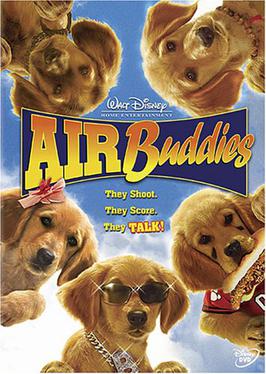
Random Movie #10: Air Buddies

And so it came to pass that, through random happenstance and Becky's willful inclusion of it in the bucket, we have seen one of Becky's "puppy movies:" the 2006 direct-to-dvd family comedy Air Buddies.  She was so insistently hung-ho for this movie that I couldn't even bribe her to remove it (I threatened to add Olympus Has Fallen, I offered to remove Crystal Fairy & the Magical Cactus).  It was inevitably going to happen, especially since she added NINE of them (Air Buddies, Treasure Buddies, Super Buddies, Santa Buddies, Spooky Buddies, Snow Buddies, Space Buddies, The Search for Santa Paws, Santa Paws 2: The Santa Pups), but that doesn't make it any easier to deal with.

After retiring from Basketball, Football, Soccer, Baseball and Volleyball, the famed Golden Retriever Air Bud settles down with the dog across the street and has a litter of pups.  But when the burden of raising Rosebud Budderball, Buddha, MudBud and B-Dawg becomes too much for the Framm family to bear, they are forced to break up the litter.  Not wanting to go to puppy foster care, they decide to run away from home.  A villainous group of exotic animal dealers, however, sees this as a $500,000 payday.


So... yeah.  This happened.


If you have any love for your children, you will give them a far better childhood than this sad Air Bud spin-off franchise has to offer.  You can identify the villain by his eye-patch and mangled German accent, so there's not really much more to say about it.  I give it a 2.5, even lower than Grave Encounters 2!  This puts it squarely in line with Bio-Dome, Dude, Where's My Car? and The Stupids.  Becky, who very obviously enjoyed this far more than I did, gave it a 5.